Implementation of a project to collect data from water meters in Kyiv
The time has come when accounting for energy consumption becomes mandatory. Installation of metering devices contributes to more economical consumption of energy resources. Approximately 24% of the country's housing stock is equipped with household cold water meters. Regardless of whether household water meters will be used for commercial or technological accounting, the housing stock must be equipped with them at 100%.
This will solve the following tasks:
- get the balance of water consumption (house, quarter, district, city);
- distribute the volume of water consumed according to the indicators of the general house meter between the residents of the house in the case of commercial accounting.
The balance of water consumption will allow you to identify cases of unauthorized connection, theft, gusts, etc. To effectively solve these problems, the following conditions must be met:
- quickly get data from water meters;
- the data obtained must be up-to-date and reliable.
These conditions are feasible only with the introduction of remote data collection and transmission systems.
In September 2013, IN-PREM implemented a pilot project to introduce the Sensus Scout remote data collection and transmission system from common house cold water meters in one of the districts of Kyiv.
Project implementation goals:
- obtain objective and up-to-date data on cold water consumption in multi-apartment residential buildings;
- eliminate the influence of the human factor on the reading of water meters;
- check the reliability of the received data by comparing the information on the counting mechanism of the meter with the data received in the process of remote reading;
- determine the range of the radio signal and the possibility of obtaining information from several water meters located in nearby buildings;
- check the reliability of the system in difficult operating conditions (basements, high humidity, the likelihood of flooding, different thickness and number of walls and ceilings in the path of the radio signal).

Objects for the implementation of the project were chosen arbitrarily. The main selection criterion was the presence of a meter with a pulse output, or with preparation for the installation of a pulse output. Both involve connecting the Scout-P radio module and a pre-installed pulse transmitter via cable. But as experience shows, it is necessary to give preference to models of water meters that can be equipped with Scout-S or Scout-Mei radio modules without an additional link in the form of a pulse transmitter, by installing the radio module directly on the meter's counting mechanism. This increases the reliability of the system and reduces the cost of its implementation. After connecting the radio module, the process of configuring it was carried out using the Psion handheld terminal. The serial number of the counter, the price of the pulse, the reading of the counting mechanism, etc. were registered in the memory of the radio module. At this point, the formation of the first level of the Scout radio system was completed. Meter readings were taken by walking around using the Psion WorkAbout Pro hand-held terminal at a distance of 10-100 meters from the outer wall of the building. The time interval during which readings were taken from one counter averaged 30 seconds. The main factor affecting the range of the radio signal is the number and thickness of the walls along its path. At one of the facilities, the basement (where the water meter was installed) had a large thickness of ceilings and walls, creating a stable barrier to the passage of the radio signal. The problem was solved by installing an auxiliary radio module, which was placed in the hole in the wall for the irrigation pipe to be used as a signal repeater. Thus, by building "chains" of radio modules, including those located at nearby objects, it is possible to transmit a signal over long distances to the Scout-Web central gateway. Using the GPRS modem built into the gateway, the received meter readings are transmitted to a remote server. In this way, the second level of the Scout radio system is created, which allows, at the request of the network operator, to collect data from the meters using the network of mobile operators without visiting the facilities.
The implementation of the first level made it possible to fulfill all the goals set before the start of the project, and the subsequent debugging of the network made it possible to further reduce the time of data collection by optimizing the route and creating signal overlap points from several radio modules, including using the "chain" method. After a detour along the route, the data obtained were transferred to a PC and exported to Excel format for further processing and analysis of water consumption at the facilities. The photographic fixation made during the next round confirmed the complete coincidence of the readings of the counting mechanism of the counters and the data on the display of the hand-held terminal.
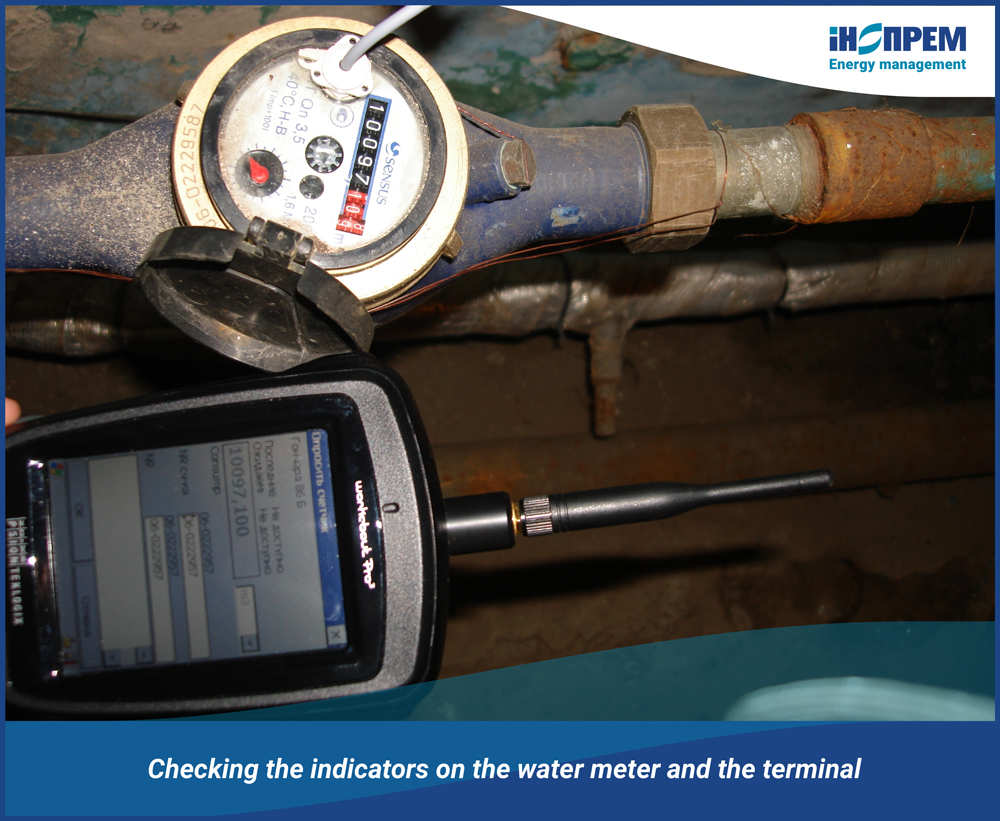
The deployed first level of the Scout system demonstrated a high degree of stability and reliability in operation, thanks to such characteristics of the radio modules as: power from the internal battery (service life up to 12 years), IP68 degree of protection (the ability to work in a flooded state), as well as independence from mobile phone operators. connections. Subject to the opening of additional funding, the implementation of the second level of the system will further optimize the process of collecting and transmitting data from meters, thereby obtaining the maximum economic effect.
Reducing the duration of the data collection process to 5 days will enable Vodokanals to reduce accounts receivable for water consumed by subscribers in the amount of monthly sales. This money can be used for investment projects of Vodokanals.
At the moment, the Sensus Scout remote data collection and transmission system is successfully operated in six settlements of Ukraine, such as Izmail, Tetiev, Vyshhorod, Cherry, Ternopil, Hatne. This system is used with new types of meters in the metrological accuracy class "C" (R160 according to the Technical Regulations), installed in multi-apartment residential buildings, in the private sector, in general house accounting, etc.
Considering all the above opportunities obtained from the introduction of remote data collection systems, it is necessary to pay attention to the fact that this tool will give the maximum economic effect only if it is applied on the basis of high-quality accounting.
Lukash Oleg
Krasnozhon Iryna


