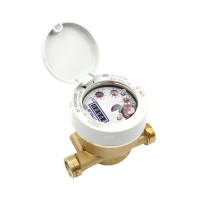
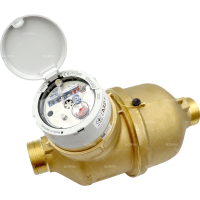
World resources of clean potable water consistently diminish each year and its price increases. In connection with this the issues of accurate metering of water consumption and checks of leakage become more acute. At present the main challenge the water and waste water treatment plants face up is to draw up to balance the volume of sold and the volume of metered water. As shown by the statistics the difference makes 40-50%. The water and waste water treatment plants lose significant sums investing means in the preparation and supply of water, receiving payment only for one half of it. Where to look for the enormous volume of lost water? If it could be attributed only to leaks each inhabited location would turn into a weird Venice. It means that the main reason is a poor, untimely metering and sometimes also its absolute lack.
Availability of measuring – the primary factor affecting the efficient and money-saving use of water. As shown by experience and statistics of water and waste water treatment plants (Ivano-Frankovsk, Ternopol, Chernivtsi etc) with increasing number of installed water meters, particularly in residential properties the consumption of water by terminal users decreases.
Quality of metering depends on the used measuring instruments. Let´s examine the components affecting the quality of metering in more details. Any water meter as a standard has certain standard value of volume flow rate set by GOST (state standard) (range of flow rates):
- sensitivity threshold (minimum fixed flow rate);
- minimum flow rate Qmin;
- transitional flow rate Qmin;
- nominal flow rate Qn;
- maximum flow rate Qmax.
In the lower range of flow rates from Qmin to Qt the water meter works with a relative error of measurements ±5 %, in the upper range from Qt to Qmax with an error ±2 %. Accordingly,the lower the error the higher the quality of measurement. Therefore water meters with a wider upper range of measuring (Qt-Qmax) are preferred and by this the lower range of measurement with a shift of its limits as close to the sensitivity threshold as possible is determined. In this the sensitivity threshold approaches to the values of flow rate close to zero.
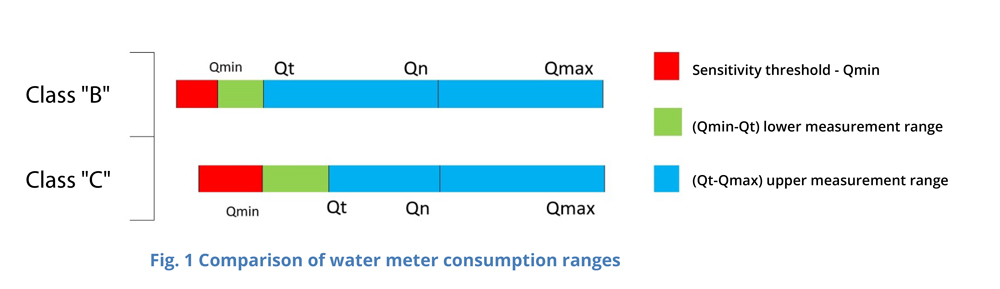
Water meters with the limit value of sensitivity close to zero with a narrow metering range (Qmin - Qt) belong to metrological class "С". Such Instruments have to be used in facilities with a non-stable dynamics of water consumption, i.e. where there is floating consumption which in case of correct selection of a water meter should not exceed the limits of Qt – Qmax. It is important that the meters in the metrological accuracy class „C“ are used in residential metering of water consumption since often there occur flow rates under the sensitivity threshold of commonly used residential water meters (leaks in toilet bowl, taps etc.) So the volume of water consumed with the flow rate under the sensitivity threshold of the water meter is not measured. For comparison: sensitivity threshold of a residential water meter in the metrological accuracy class „B“ makes 15l/h, in class „C“ – less than 4l/h. In facilities with a stable water consumption it is not necessary to use highly precise instruments. In this case it is possible to use meters of accuracy class „B“. However it is necessary to meet the condition that the consumption flow rate in the facilities has to lie in the upper range of measuring of the meters (Qt-Qmax) with relative error of measurement ±2 %. When selecting the meters it is always necessary to take into consideration the value of quantity of loss in water pressure in the system caused by the resistance of the installed meter. For multi-jet water meters the loss of pressure at the meter with operating flow rate has to be maximum 25 kPa, with turbine meters not higher than 10 kPa.
Often water meters with oversized diameter are installed in the facilities. It leads to the fact that the instrument designed to work in higher flow rates becomes insensitive to small flow rates in the given facility usually occurring at night or caused by certain technological cycles of the production. In this situation the operating flow rate falls into the lower range of measuring of the instrument. This problem is particularly critical in the last 5 years when water consumption by all groups of users decreases each year by 10-15%, accordingly the consumption modes are changed. In order to improve the quality of measurement of water consumption under these new circumstances it is necessary to work on complex optimization of measurement based on well thought-out selection and possible replacement of existing points of water consumption measurement by new ones, taking into consideration actually existing load (flow rates). In some facilities (schools, swimming pools, hospitals etc.),where with regard to certain circumstances periodically repeated high consumption occurs (daily preparation of food, filling of the swimming pool etc) beside insignificant basic operating consumption (sanitary conveniences) it is recommended to use combined or double-chamber water meters – Meitwin. It is also necessary to use such water meters in the facilities where it is necessary to ensure the observance of the requirements and standards of fire prevention - short, however high consumptions.
One of the important factors affecting the quality of consumption measurement is the existence of a reliable protection of the water meter against unauthorized interference. There are many ways how to affect the water meter with the main objective – to block its operation partially or fully. The most popular of them is to affect it by an external magnet. Therefore when selecting a water meter it is necessary to consider the level of its anti-magnetic protection and to prefer those meters where the counting mechanism is made as a vacuum-sealed capsule „copper-glass“. To get to the drums of the counting mechanism with the aim to change intentionally the readings it has to be fully broken. Moreover such type of counting mechanisms enables the operation of the water meter when fully flooded. A 100% anti-magnetic protection exists with two types of water meters - „wet-dial“ and „semi-wet dial“ where the construction is without the magnetic coupling by means of which the rotation of the blade wheel is transferred to the counting mechanism. With instruments of the type „semi-wet dial“ the main disadvantage of wet-dials is missing – pollution of the counting mechanism by impurities from water since the counting mechanism of „semi-wet dials“ is made as a vacuumed capsule filled by special liquid.
Ill-timed measuring is one of the factors affecting the balance of water consumption. At present the collection of data on consumption of water by users is made over a month or longer by controllers of enterprises rendering services in water supply visually or by telephone and it results in errors, loss of time and lack of actual balance. Organizations rendering services in water supply should seek to implement the systems of automated reading and transfer of data remotely.
It follows from the above mentioned that it is necessary to approach the problem of water consumption metering comprehensively. Installation or replacement of water meters themselves do not solve the existing problem of disbalance. The company “IN Prem“, at present the only one in the Ukraine, offers it services in a complex approach to the issue of measuring water consumption and it is the examination of the water consumption regime in the facility with the help of data archiver Data Logger, obtaining of charts of water consumption, selection of water meter in accordance with the received charts and also organization of systems of remote transmission of data.
It should be better to explain the issue of a the complex approach in the sphere of water consumption metering in the sector of residential locations. According to data of water supply and water waste treatment plants the main consumer of water is the public with a 70-80% share in the general volume of water consumption. Accordingly the basic loss has to be sought particularly in this sector. The main problem of water and waste water treatment plants and housing department is the difference of readings of residential water meters in the common house water meter. According to experience the balance of water consumption in a house with many flats is negative and in average it makes 25-45 %.
The basic component of the difference arises because of installation of water meters in vertical position which leads to the loss of their sensitivity, deliberate theft of water (application of magnets etc.) and also because of use of residential water meters with metrological characteristics not allowing to make measurements at small flow rates (leak of toilette bowls, taps etc.) which cumulate in the whole house and amount to the volume of consumption registered by the common house water meter. With water consumption with flow rate under the sensitivity threshold of water meter the apartment dweller acquires legitimate right no to pay for the consumed water and it is one of the components of the negative balance of water consumption of the whole house. According to data of Data Logger archiver charts at night where there practically shouldn´t be any water consumption,leakage in a nine-store two-entry block of flats amount to 3 to 4 m3/hour. There arises a question: how to measure this volume of water and cut the difference to minimum? It appears it can be solved by the installation of highly precise residential water meter with which the sensitivity threshold is closer to zero flow rate, and they do not change their metrological characteristics in any position in the pipes and having also a 100% antimagnetic protection. This shall allow to reduce to minimum the losses of measurement of volume of water at small flow-rates.
The company „IN-Prem“ prepared and in September 2009 together with the control point „Ternopolvodokanal“ implemented the pilot project of equipment of a 5-store two-entry block of flats („Experimental House“) with highly sensitive residential water meters (of „820“ type) installed in vertical position and a common house water meter (of the type „620“, metrological accuracy class „C“) with the organization of a system of remote transfer of data „SensuScout“. The objective of this project was to reduce to minimum losses occurring in the selected facility, to prove the necessity to use highly sensitive meters and also to obtain the possibility to immediately read the data of the water meters without disturbing the users.
In order to implement such project highly sensitive residential water meters were selected of the metrological accuracy class „C“ (of the type „820“). Main advantages of such water meters:
- sensitivity threshold (minimum flow rate recorder by the water meter) was less than 4l/h;
- possibility of vertical installation withot losing sensitivity;
- 100% anti-magnetic („semi-wet dial“, the water meter is constructed without a magnetic coupling);
- counting mechanism executed as a capsule filled by glycerine which enables to avoid the pollution of the counting mechanism;
- possibility of connection to the system or remote reading of data;
- calibration interval – 4 years.
When selecting the system of transfer of data from water meters „SensuScout“ the decisive factors were the following ones:
- wireless method of data transfer
- autonomous power supply;
- possibility to get current data from a large number of water meters in a short time;
- independent from communication operators and other mediators rendering services in data transmission;
- possibility to extend the system by means of increase of the quantity of examined appliances without any additional reorganization;
- possibility to add water meters as well as heat meters to the system.
The principle of operation of the system „SensusScout“ is very simple. All meters from which it is necessary to read the information are equipped with radio modules. Operating personnel of the supplier of the service (water and waste water treatment plant or housing department) having a wireless terminal with pre-programmed factory numbers of the water meters, address of their placement, last readings, go or drive along a planned route past the meters in the distance 50-500 m. The radio module placed in the operation zone of the wireless terminal responds to the inquiry by a package of data including the readings of the water meter. One wireless terminal can get data from an unlimited number of radio modules.
According to statistical data of the control point „Ternopolvodokanal“ the difference between the readings of the common house water meter and the aggregate readings of residential water meters for the period from January through March 2009 ranged from 4 to 58%. During the experiment the disbalance made 0.4% and it remains stable already for 6 months.
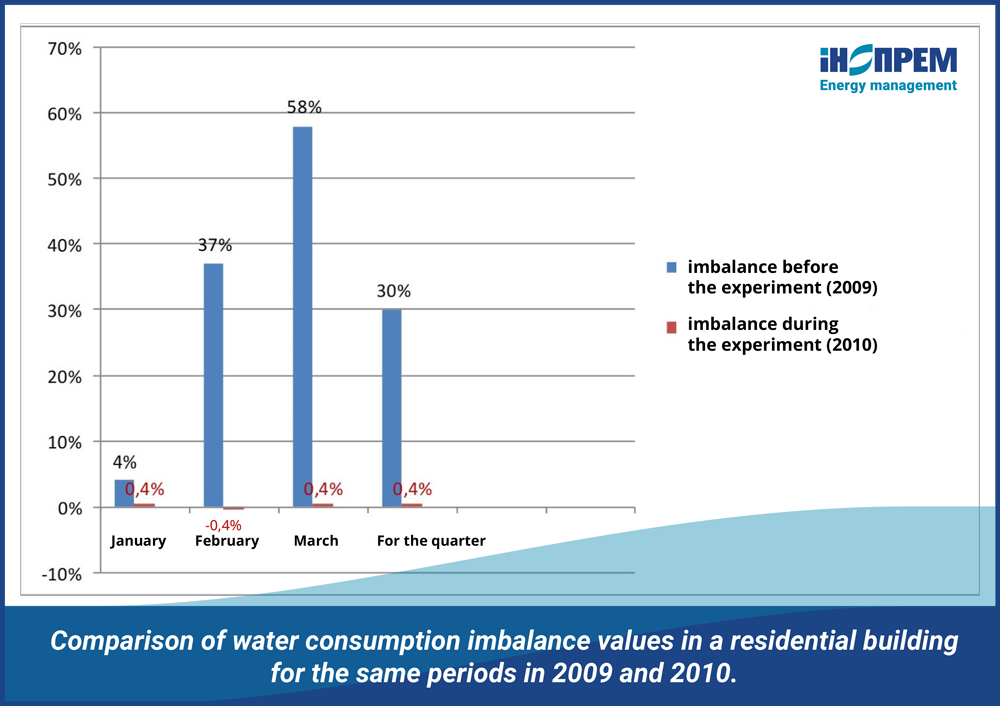
As we can see the chart monitors instability of values of the disbalance in 2009. This phenomenon is caused by the lack of data as of the moment of drawing up a balance. Frequently the readings were announced by the users by phone and they were also read in accordance with the standard. The application of the system of data transfer „SensusScout“ together with the use of highly precise residential water meters enabled:
- to get the balance in the house to 0.4 % and achieve its stability;
- to receive in a short time data on consumption of water as of the determined day in the month and to issue invoices;
- to make an analysis of received data and to react to occurred deviations.
The size of disbalance for the Ist
quarter 2009 made 30%. For the
comparable period in 2010 only 0.4%.
In this block of flats 29.6%
of water not measured previously have been „found“. This indication might be
much higher and achieve 40% and in some cases even more. Economical efficiency
of installation of highly precise water meters of the metrological class “C” is
fully justified.